
Matrix by Shared Kernel.Opinionated AI platform
for business solutions.
THE SOLUTION STRUCTURE
Your applications.
A common foundation.
Build complete applications in code, with shared services that connect them.
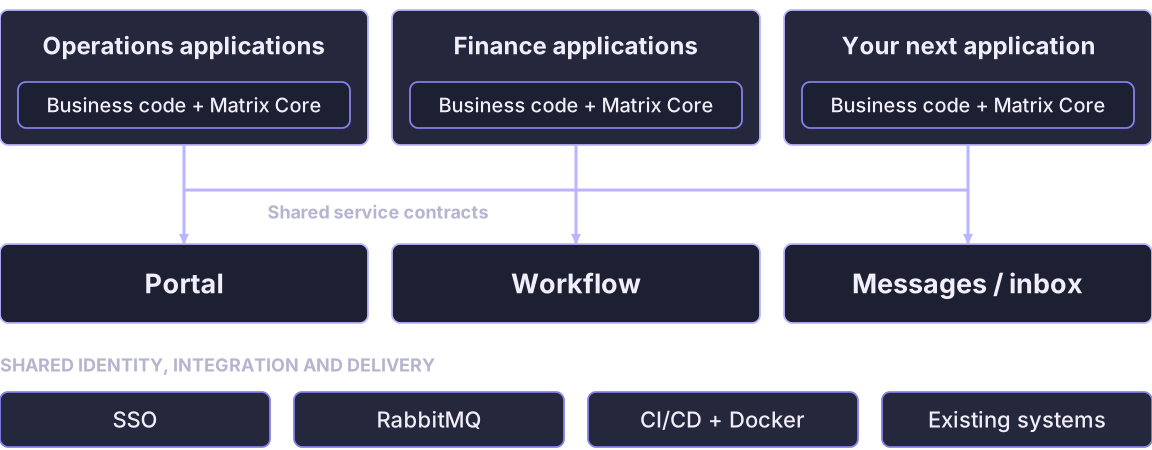
Code, integration and deployment
Your domain logic and custom interfaces stay in full .NET applications. Matrix Core is used inside those applications; Portal, Workflow and Messages provide shared services. LLM skills and opinionated developer guidance support implementation. CI/CD and Docker practices support delivery. Legacy modernization proceeds through explicit interfaces, data ownership, tests and planned cutovers. Kubernetes remains a future deployment target.
AI on both sides.
A contract at the centre.

What makes the contract deterministic?
AI can generate code or interpret a request. The application executes defined interfaces, permissions and business rules against explicit workflow state. Matrix supplies the contracts and development guidance; Shared Kernel helps your team implement and verify the behavior. AI-generated output remains probabilistic.
PORTAL AND IDENTITY
One place to start.
Connected applications.
Users sign in, find their applications and reach their work.
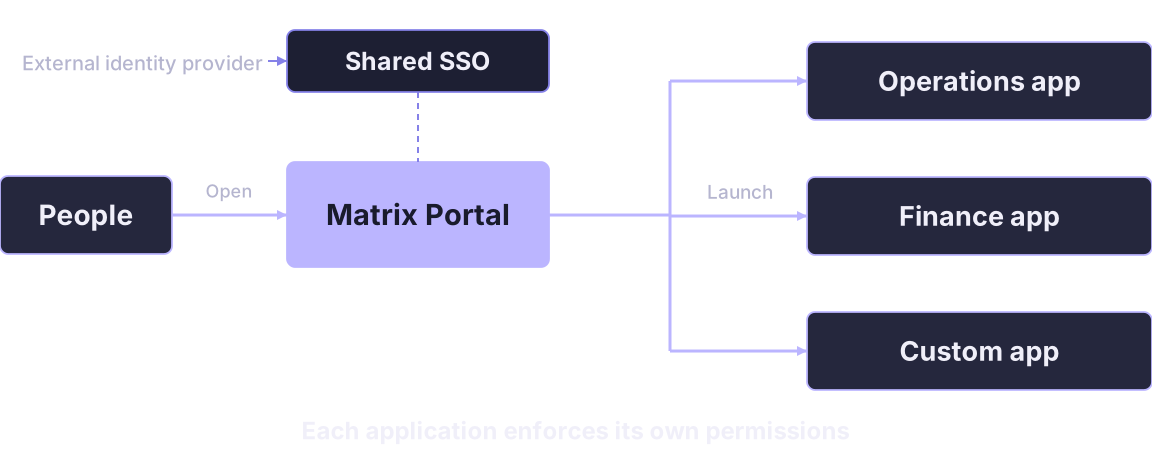
How access works
Matrix Portal launches enrolled applications. Shared SSO can integrate external identity providers, while each application applies its own authorization policy. The common inbox presents work from participating applications. Reading a notification does not complete its underlying business task.
WORKFLOW AND MESSAGING
People decide.
Services execute.
See the business process, then the messages that connect it.
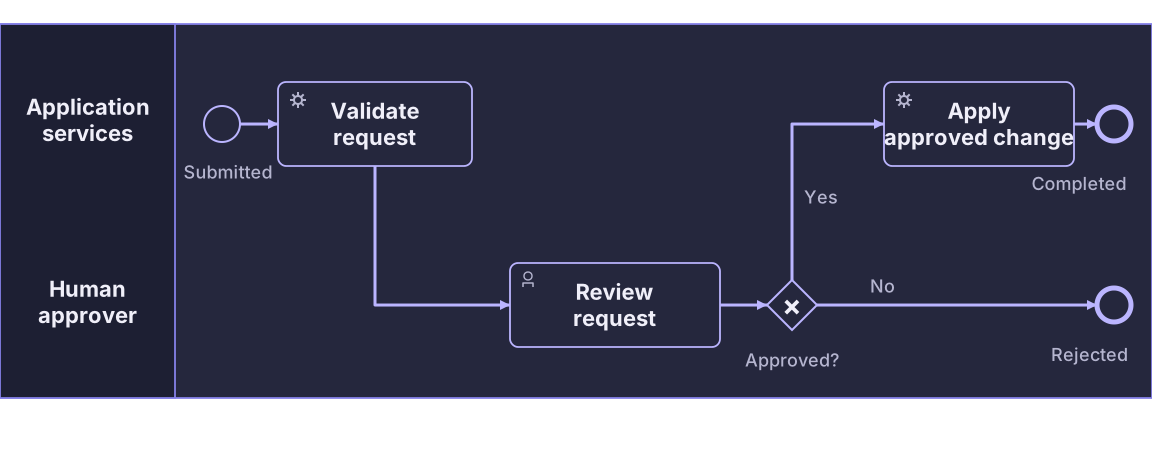
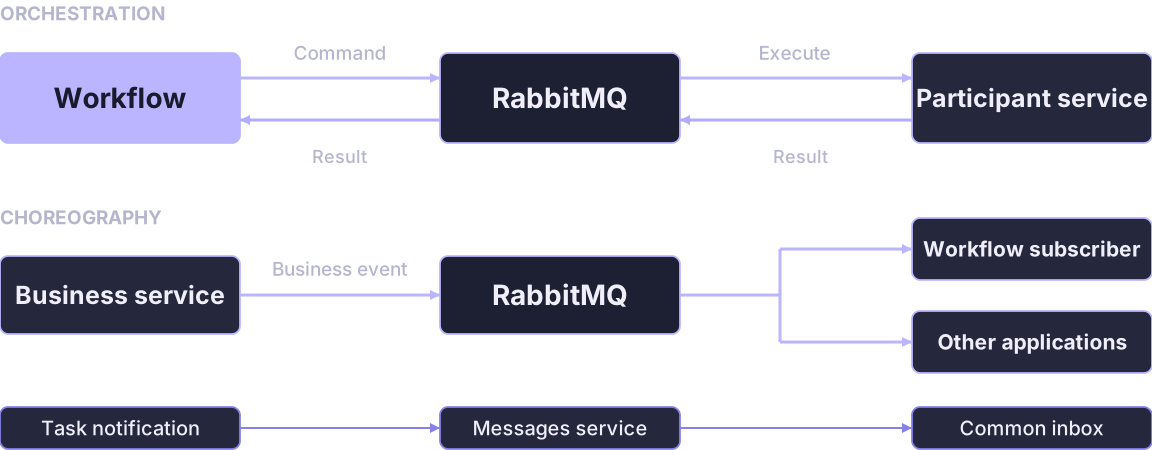
Process ownership and messaging
Workflow owns decisions and process progress. Application services own business changes. Messaging transports commands and events; Messages provides the human inbox. A transport acknowledgement is not business completion. Shared Kernel qualifies the supported BPMN profile for your use case and verifies retries, duplicate handling and failure paths.
SHARED KERNEL
The platform engineers.
Inside your team.
We develop Matrix and co-develop your solutions at your premises.
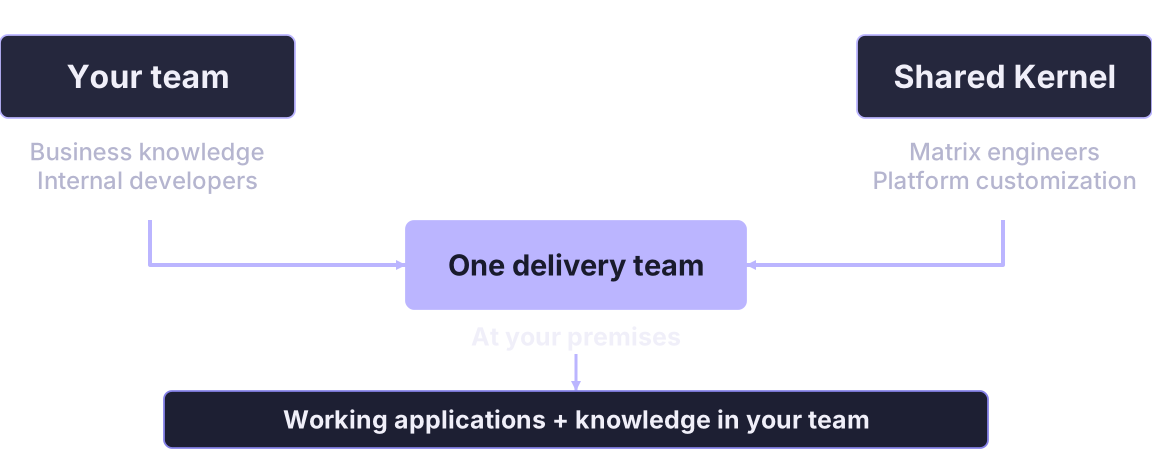
What the engagement includes
Experienced practising engineers work with your developers and business teams on architecture, platform customization and implementation. We apply domain-driven design, project planning, work tracking, code review and meaningful tests. Documentation and knowledge transfer build internal capability, with maintenance and support responsibilities agreed for ongoing operation.
SECURITY AND QUALITY
Controls you can verify.
Security and audit integration
Shared services reduce the infrastructure responsibilities and exposed interfaces of individual applications. Shared Kernel helps configure and verify identity, application permissions and business rules. Retained audit evidence requires durable storage, controlled access and a retention policy. Acceptance applies to the selected release in your environment.
NIS2 support
Matrix and Shared Kernel can support the engineering work within your NIS2 programme through secure development practices, access controls, retained audit evidence and recovery verification. Compliance depends on your organization’s scope, governance and operation of its controls. Deploying the platform does not establish compliance on its own.
YOUR FIRST APPLICATION
Build it together.
Decide with evidence.
- 01Choose the use case
- 02Build and verify
- 03Assess wider adoption
The investment decision
Agree a bounded use case, integration boundaries and acceptance criteria. Review actual effort, support needs and your team’s ability to make a change. A second use case tests reuse. Confirm the supported capability baseline, licensing, source access, application rights, integration and training costs, maintenance responsibilities and exit arrangements before wider investment.